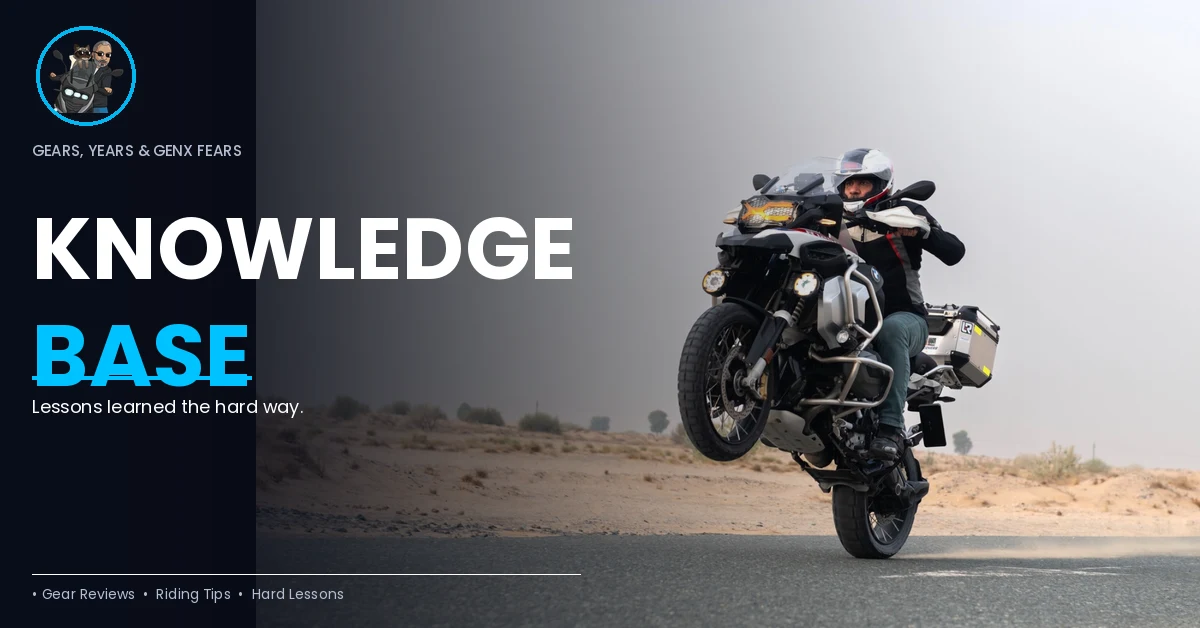
Rider Knowledge Base — Lessons learned the hard way
Rider Resources

Knowledge Base

Practical guides, gear picks, and hard-won lessons from the road

Browse Topics

Six things we keep getting asked about

🏍️
Guide 01

Beginner’s Guide to ADV Riding

Starting big — what they don’t tell you about getting on an adventure tourer for the first time.

Should You Start on a Big GS?

The honest answer: not necessarily. The BMW R1250 GS Adventure is an extraordinary machine, but it is also 268kg wet, with a 890mm seat height, and will humble you at low speeds. If you are new to riding, start on something smaller — a 650cc or 800cc single or parallel twin gives you the ADV experience without the moment of regret when you drop it in a petrol station car park.

That said, if you have experience on other bikes and want to go straight to the big GS: do it. Respect the weight, practice slow-speed manoeuvres until they are second nature, and accept that you will drop it at least once. Everyone does. Asad’s Manchalee has the scratches to prove it.

Essential Gear Checklist

Before you ride anywhere, get these sorted. This is the difference between walking away and not:

  • Helmet — full-face, ECE 22.06 or DOT/Snell certified. ADV-style with good ventilation for the UAE climate.
  • Jacket — CE Level 2 armour at shoulders and elbows. Mesh with armoured liner is the UAE sweet spot in summer.
  • Gloves — CE Level 1 at minimum. Summer gloves with palm sliders and knuckle protection. Never ride without them.
  • Trousers — armoured riding trousers with CE Level 1 knee and hip protection. Regular jeans offer near-zero abrasion resistance.
  • Boots — ankle-covering at minimum. ADV boots with ankle protection are the standard.
  • Back protector — often absent or Level 1 in jackets. Upgrade to CE Level 2 separately. Your spine is worth it.

Your First Desert Ride

Sand and gravel at speed. Slow down well before any loose surface. Stand on the pegs. Look where you want to go, not at the sand. Let the front wheel find its own path.

Heat starts early. A 6am start gives you two to three hours of comfortable riding before the temperature climbs past 35°C. After 10am in summer, you are riding in a furnace. Plan accordingly.

Water is not optional. Carry at least two litres. Dehydration at riding speed is a serious risk — you feel fine until you don’t.

Tip from the road

Your first 3,000km on an ADV bike will teach you more than any YouTube video. Ride regularly, ride in groups when you can, and don’t be afraid to ask questions at the petrol stop.

↑ Back to topics
🇦🇪
Guide 02

Riding in Dubai & UAE

Routes worth riding, heat survival strategies, and how to find your tribe in the UAE riding community.

Best Routes in the UAE

  • Jebel Jais, Ras Al Khaimah — the UAE’s highest road with mountain switchbacks and sweeping views. Best ridden early morning on a weekday.
  • Hatta Mountain Road (D44) — Dubai to Hatta via sweeping turns through rocky desert. 90 minutes from central Dubai.
  • Fujairah Coast Road (E99) — the east coast highway from Dibba south toward Khor Fakkan. Ocean on one side, mountains on the other.
  • Al Ain via E22 — long desert highway riding, fast and flat. Good for clearing your head and covering miles.
  • Khorfakkan to Dibba — tight coastal curves with fishing villages along the way. More technical and lighter traffic than Jebel Jais.

Riding in 45°C — Heat Management

  • Start at 5:30–6am. By 9am in July it’s already 38°C. By noon in summer, stop.
  • Hydration pack or tank bag water. Drink before you feel thirsty. A 90-minute summer ride means minimum one litre.
  • Mesh jacket, always. A solid textile jacket in 45°C will overheat you. Mesh with armour inserts is the UAE summer standard.
  • Ice vest or cooling towel. An ice vest under your jacket on a long summer ride is a genuine game-changer.
  • Know heat exhaustion signs. Dizziness, nausea, confusion — pull over immediately, shade, water, rest.

Traffic Reality in the UAE

On a motorcycle, assume the following: the car next to you has not seen you, is about to change lanes without indicating, and is on a phone. Position yourself accordingly. Stay out of blind spots, maintain a buffer zone, and always have an escape route.

The E311 and Sheikh Zayed Road at peak hours are not places to test throttle response. Early morning weekend riding on the E66 toward Al Ain is a completely different and meditative experience.

Community Rides

The UAE has a thriving riding community. Groups to look up include the GS Club UAE, GS Nation UAE, and Bad Monkeys MC. The Eid Brotherhood Ride brings together hundreds of riders across all nationalities — 350 bikes and 41 nationalities in 2026 alone.

↑ Back to topics
🔧
Guide 03

Motorcycle Maintenance Basics

The checks that keep you rolling — and out of the breakdown lane on the E311 at 7am.

The Pre-Ride Checklist (T-CLOCS)

T-CLOCS is the standard pre-ride inspection framework. Takes 3 minutes. Worth forming the habit early:

  • T — Tyres & Wheels. Tyre pressure (check cold — UAE heat inflates pressure), tread depth, any visible damage, wheel nuts tight.
  • C — Controls. Clutch and front brake lever free play. Throttle smooth with no sticking. Rear brake pedal firm.
  • L — Lights & Electrics. Headlight, tail light, indicators. Battery voltage if you have a gauge.
  • O — Oil & Fluids. Engine oil level. Coolant reservoir. Brake fluid (front and rear). Fork seals for any weeping oil.
  • C — Chassis. Front and rear suspension — push down on each end, feel for smooth return. No creaks from the steering head.
  • S — Stands. Centre stand and side stand retract fully and do not drag in corners.

Oil Changes

Most modern motorcycles need an oil change every 5,000–6,000km or annually. The BMW R1250 GS uses synthetic oil (0W-40 or 5W-40) and has a 10,000km nominal interval — but in UAE heat Asad changes at 7,500km. Use quality oil. The dirhams saved on cheap oil are not worth a seized engine.

Tyre Pressure

Check cold every week and before any long ride. For the BMW R1250 GS Adventure: typically 2.5 bar front / 2.9 bar rear solo, 2.5 / 3.0 with luggage (check your manual). Under-inflated tyres heat up faster and handle unpredictably. Over-inflated tyres reduce grip. The difference of 0.2 bar is noticeable on a twisty road.

Chain Lubrication

If your bike has a chain drive (not shaft drive like the GS), lube it every 500–800km or after every wash. A dry, rusty chain is a safety issue. Check tension too — a stretched chain skips under acceleration and destroys sprockets. Three minutes with a chain lube spray after every few rides is all it takes.

Worth knowing

The most common reason riders are stranded is a flat tyre, not a mechanical failure. Carry a tubeless plug kit and CO2 cartridges. Ten minutes to learn, has saved dozens of riders from calling a recovery truck.

↑ Back to topics
☀️
Guide 04

Gear Guide for Hot Climates

How to stay armoured and not cooked alive when summer riding in the Gulf.

The False Choice: Comfort vs Safety

Many UAE riders silently trade armour for comfort in summer — shorts and a t-shirt because it’s “too hot.” This is a false trade. The few degrees of temperature difference from removing your jacket cost you everything in a crash. The goal is gear that keeps you protected and does not make 40°C riding miserable. The gear exists.

Mesh Jackets

A quality mesh jacket with CE Level 2 armour at shoulders and elbows, plus a Level 2 back protector inserted separately, is the gold standard for UAE summer riding. Brands like Alpinestars, Rev’It, and Klim make excellent summer-specific options. The airflow through mesh at highway speeds creates a genuine cooling effect that solid textile cannot match.

Look for: CE Level 2 shoulder and elbow inserts included, CE Level 2 back protector pocket, full-length front zip, stretch panels for movement.

Vented Helmets

A well-ventilated full-face is better than an open-face in UAE summer. At highway speeds, a full-face with good ventilation channels air more efficiently than an open-face, and protects your face from sun, wind, and debris. Look for large intake vents at chin bar and forehead, exhaust vents at the rear.

A photochromic visor or a helmet with a built-in drop-down sun visor is the most practical UAE solution for varying light conditions.

Hydration

A hydration pack (CamelBak-style) worn under your jacket is the most effective system for long UAE summer rides. A 2-litre bladder with a drinking tube through your jacket collar means hydrating without stopping. Electrolyte tablets in your water matter on rides over 90 minutes — plain water alone doesn’t replace what you lose sweating in full gear at 40°C.

CE Armour Standards

CE Level 1 is the legal minimum. CE Level 2 is meaningfully better at absorbing impact energy and worth the price premium for back, shoulders, and knees. Check the label: “CE EN 1621-1:2012” is the European standard. Level 2 is marked clearly. This is not marketing — it is tested, measured impact absorption performance.

↑ Back to topics
🌍
Guide 05

Planning a Moto Trip Abroad

Paperwork, packing, and what actually happens when you rent a GS in Canada.

Option 1: Shipping Your Own Bike

Shipping your motorcycle internationally requires significant paperwork, cost, and lead time. The key document is the Carnet de Passages en Douane (CPD) — a customs passport that lets you take your bike across borders without paying import duty. UAE-based riders can approach the Emirates Automobile and Touring Club (EATC) for assistance.

Budget AED 1,500–3,000 for the carnet depending on the bike’s value, plus AED 5,000–15,000 return shipping. Your UAE insurance almost certainly does not cover overseas riding — arrange separate cover.

Option 2: Renting Abroad (The Practical Choice)

For most overseas trips, renting makes more sense than shipping. Asad’s Canada trip was done on a rented BMW GS from an Ontario dealership. The experience was excellent: well-maintained bike, straightforward paperwork, and riding the same model you know at home means zero adjustment time.

Book 4–6 weeks in advance in peak season. Bring your UAE driving licence and an International Driving Permit (IDP) — UAE post offices issue these same-day. Confirm insurance coverage in writing and understand the excess.

Packing for a Moto Trip

The golden rule: pack it, test ride it, remove 30% of it, then go. The pack list that works for a 7–14 day trip:

  • Riding gear — one jacket, one set of trousers, two pairs of gloves (dry and waterproof), one pair of boots.
  • Clothing — 3–4 days of casual wear. Merino wool base layers resist odour and dry overnight.
  • Toolkit — tyre plugs, CO2, hex keys, cable ties, duct tape, spare fuses, chain lube if applicable.
  • Navigation — GPS or phone mount with offline maps. Don’t rely on data roaming in remote areas.
  • Documents — passport, licence, IDP, insurance, emergency contacts card in your jacket pocket.

The Canada Experience

Ontario backroads in autumn are nothing like the UAE. Tighter corners, more varied surfaces, and the temperature drops fast after 4pm. The riding is spectacular — and the biker culture is immediately recognisable. Wave culture, petrol station conversations, roadside diner camaraderie. The throttle speaks the same language everywhere.

“You don’t realise how universal the biker spirit is until a complete stranger in a Tim Hortons car park spends 20 minutes telling you about the best road in Ontario. That conversation happened three times in one week.”

↑ Back to topics
🧠
Guide 06

Mental Health & Riding

Why the throttle works better than the therapy session — and when to use both.

Throttle Therapy: What It Actually Means

The phrase gets used loosely, but there is something real underneath it. Riding a motorcycle at any meaningful speed requires complete presence. You cannot ruminate about a difficult conversation at work while managing a 270kg bike through a mountain switchback. The mental load of riding crowds out the mental load of everything else.

This is not escapism — it is attentional redirection. The same mechanism that makes mindfulness meditation effective operates on a motorcycle. You are forced into the present moment by the nature of the task. The difference is that motorcycling does it with more torque.

The GenX Approach to Stress

There is a particular flavour of midlife pressure that GenX riders know well: career at peak load, children leaving home, parents ageing, and the slow reckoning with what the second half of life looks like. The corporate hamster wheel at full speed.

Riding cuts through this cleanly. Not permanently — the problems are still there when you take the helmet off — but two hours on an empty road has a genuine rebalancing effect. You return to the same problems slightly larger than you were when you left.

Riding as Meditation — The Practice

Solo early morning rides are the most meditative form of motorcycling. Empty roads, low traffic, the rhythm of the engine, and enough visual input to keep the mind engaged without overwhelming it. The UAE provides this reliably between 5:30 and 8am on weekend mornings.

For the practice to work: leave the earphones out. No podcasts, no music at full volume. Let the ride be the content. The mind will settle on its own if you give it the space and the road.

When Riding Is Not Enough

Throttle therapy has real limits. If you are riding to avoid dealing with something rather than to process it, the avoidance will accumulate. The bike is a tool for perspective, not a substitute for addressing the underlying issue.

If the weight feels genuinely unmanageable — persistent low mood, loss of interest in things that used to matter, significant anxiety that riding does not touch — speaking to someone is not a weakness. It is the same logic as consulting a mechanic for a problem you cannot diagnose yourself.

The riding community, for all its banter and bravado, has a surprising amount of quiet solidarity around this. The conversations at the side of the road, away from the bikes, often matter as much as the rides themselves.

Worth remembering

Moku gave this channel its name — a rescue cat who found the family and stayed, a reminder that small acts of kindness have long echoes. His spirit lives on in every ride and every post.

↑ Back to topics
Still Have a Question?

Ask in the Comments

Every guide on this page started as a question from a fellow rider. If you didn’t find what you were looking for, drop it in the YouTube comments — Asad reads them all and answers as many as he can.

►  Visit the YouTube Channel Send a Message